
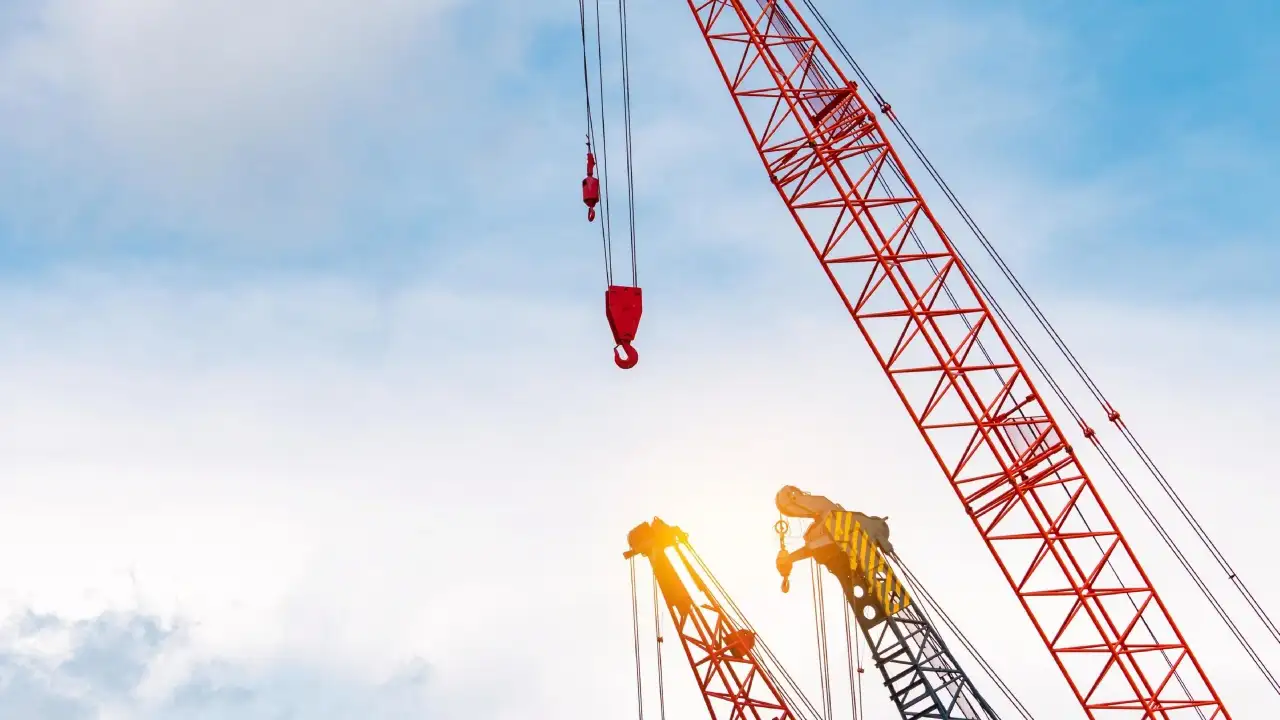
Walk onto any large construction site or shipyard, and you will spot them immediately. They are the titans of the industry—the crawler cranes and friction cranes that have been moving the world’s heaviest loads for decades. Some of these machines were built in the 1970s or 80s, yet they work alongside modern hydraulic units, often out-lifting them.
We tend to judge the health of these machines by what we can see and look for rust on the boom. We look for oil leaks on the deck and look for frayed wire ropes.
But the most dangerous threat to a crane’s structural integrity is something you cannot see with the naked eye. It is not chemical (rust); it is mechanical. It is a phenomenon known as “Metal Fatigue,” and for the owners of legacy equipment, it is the invisible clock ticking inside the steel.
The Paperclip Analogy
To understand metal fatigue, you don’t need a degree in metallurgy; you just need a paperclip.
If you take a paperclip and bend it 90 degrees, it doesn’t break. You can bend it back, and it still holds its shape. But if you bend it back and forth, over and over again, eventually it snaps.
Crucially, the paperclip does not snap because you pulled it too hard. It snaps because you cycled it too many times.
This is exactly what happens to a crane. Every time a crane picks up a load, the steel structure deflects. The boom chords compress. The pendant lines stretch. When the load is set down, the steel relaxes.
This is one “Stress Cycle.”
Engineers use something called the S-N Curve (Stress vs. Number of Cycles) to predict the life of a part. Modern machines are designed with finite lifespans. But many vintage cranes were built in an era of “infinite life” design philosophies, using massive safety factors. However, even the strongest steel has a limit. After 50 years and hundreds of thousands of cycles, the microscopic grain structure of the metal begins to change.
The Birth of a Micro-Crack
Fatigue failure doesn’t happen all at once. It starts at a microscopic level, usually at a “stress riser.”
A stress riser can be anything that interrupts the smooth flow of force through the metal. It could be a tiny pit of corrosion, a scratch from a tool, a sharp corner in a casting, or an impurity in the steel itself.
Under cyclic loading, the atomic bonds at this stress riser begin to shear. A crack forms. This crack is often smaller than a human hair. You could inspect the crane with a magnifying glass and never see it.
But once the crack exists, it acts as a wedge. Every time the crane lifts a load, the crack opens slightly. Every time it drops the load, the crack closes. With each cycle, the crack propagates deeper into the material.
Eventually, the remaining healthy steel is too thin to support the load. The next time the operator pulls the lever—even with a load well within the safe working limit—the part snaps instantly. This is why fatigue failures are so terrifying: they occur without warning, often under normal operating conditions.
The “American” Legacy and the Fatigue Factor
This issue is particularly relevant to the legendary “American” style friction cranes (like the 900 or 11000 series). These machines are engineering marvels, revered for their simplicity and brute strength. Because they were built so well, they have survived long enough to reach the fatigue limit of their components.
A modern hydraulic crane might be retired after 15 years due to electronic or hydraulic obsolescence. A vintage lattice boom crane keeps going. This means the shaft, the gears, and the boom lacings are accumulating a cycle count that the original designers may never have anticipated.
The danger zones on these legacy giants are specific:
- The Boom Lacings: The lattice work of the boom handles complex tension and compression. The weld points where the lacings meet the main chords are prime locations for fatigue cracking.
- The Swing Shaft: The vertical shaft that drives the rotation of the upper works experiences massive torque twisting (torsion) every time the crane swings.
- The Hook Block: The hook handles the direct weight of every single lift.
Seeing the Invisible: Non-Destructive Testing (NDT)
So, if you can’t see fatigue with your eyes, how do you know if your crane is a ticking time bomb? You have to use science to look inside the steel.
This is the realm of Non-Destructive Testing (NDT). Crane inspectors use three primary methods to hunt for fatigue:
- Magnetic Particle Inspection (MPI): This is used for ferromagnetic materials (iron and steel). A strong magnetic field is introduced into the part (like a hook or a gear). Then, fine iron particles—often fluorescent—are dusted onto the surface.
If there is a surface crack, it interrupts the magnetic field, causing “flux leakage.” The iron particles cluster around the leak, effectively drawing a bright line right over the invisible crack.
- Ultrasonic Testing (UT): This works like a medical ultrasound. High-frequency sound waves are sent into the metal. When the sound wave hits a crack or a void inside the metal, it bounces back. By measuring the time it takes for the echo to return, inspectors can map the internal structure of a shaft or pin without ever taking it apart.
- Dye Penetrant: For non-magnetic parts (like bronze bushings or aluminum), inspectors use a liquid dye with low surface tension. The dye is sprayed on the part and allowed to seep into any cracks. The surface is wiped clean, and a “developer” powder is applied. The developer sucks the dye out of the cracks like a blotter, revealing red lines on a white background.
The Replacement Philosophy
When fatigue is found, the solution is rarely a repair. You generally cannot weld a fatigue crack, because the heat of the weld changes the grain structure of the surrounding metal, creating a new, brittle heat-affected zone that will just crack again.
The solution is replacement. But this introduces a final challenge: Sourcing.
If you are replacing a shaft on a 40-year-old machine, you cannot simply machine a piece of generic bar stock to the same dimensions. You must match the metallurgy. The original engineers chose specific alloys—4140 steel, 4340 steel, or manganese bronze—for their specific fatigue-resistant properties.
Using a “will-fit” part made of inferior steel is a recipe for disaster. The new part may look identical, but if it lacks the tensile strength or the heat treatment of the original, it will fail in a fraction of the cycles.
Conclusion
The longevity of heavy machinery is a testament to the manufacturing prowess of the past. But steel has a memory. It remembers every lift, every swing, and every shock load.
Owning and operating legacy equipment requires a shift in mindset from “maintenance” to “preservation.” It means accepting that rust is ugly, but fatigue is deadly. It means investing in regular NDT inspections to find the micro-cracks before they become headlines.
And most importantly, it means respecting the pedigree of the machine. When the time comes to swap out a worn gear or a tired boom section, finding high-quality, spec-complian American crane parts is not just about keeping the machine running; it is about honoring the physics that have kept it standing for half a century. In the war against metal fatigue, quality materials are the only shield we have.
For more informative articles, visit our site daily.