
If you were to paint a mental picture of bass fishing in the American South, it would likely involve a quiet, mossy cove. You would picture a boat drifting slowly along the shoreline, an angler casting a lure toward a fallen log or a patch of lily pads. It is a game of targets, shallow water, and stealth.
But if you bring that mindset to the Georgia-South Carolina border, you are going to have a long, frustrating day.
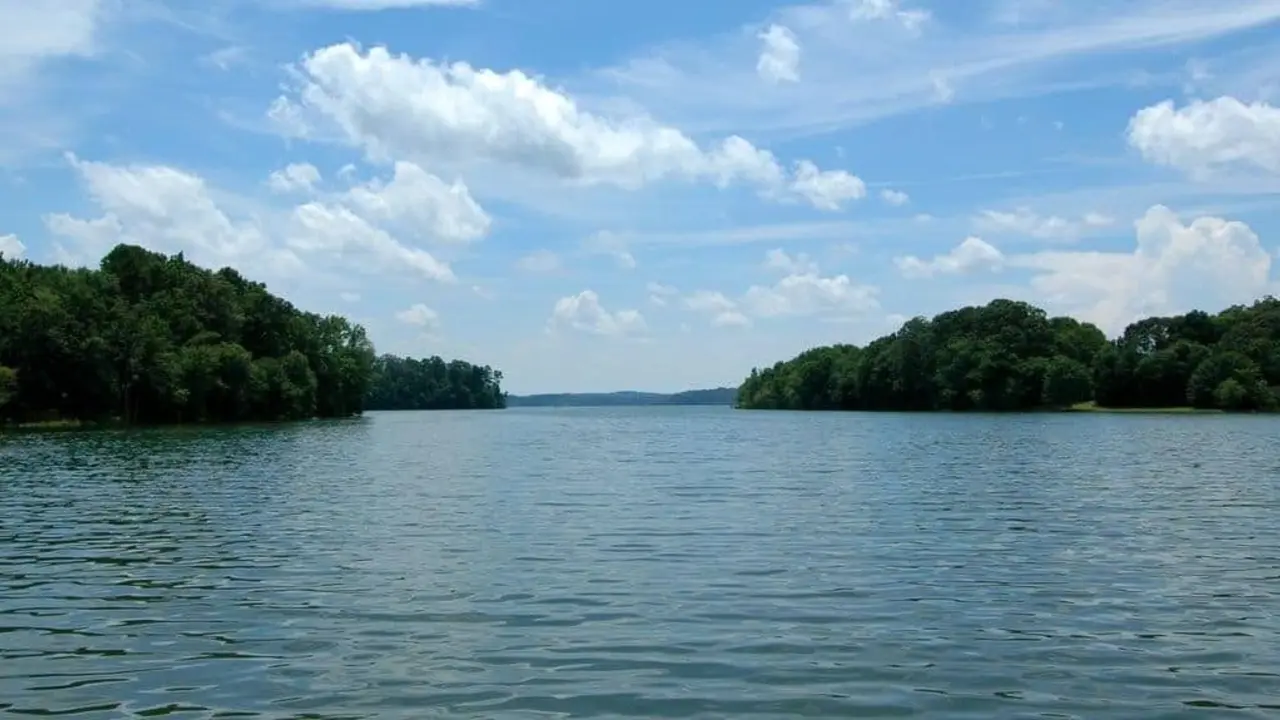
On this massive 56,000-acre reservoir, the rules of engagement have changed. Here, the top predators don’t behave like lazy ambush predators hiding in the shadows. They behave like oceanic hunters. They roam the open basins in “wolf packs,” chasing bait at breakneck speeds over water that is 100 feet deep.
This phenomenon is known as the “Inland Ocean” effect, and it is caused by the presence of a single, silvery intruder: the Blueback Herring.
The Saltwater Intruder
The Blueback Herring is an anadromous fish. By design, it is supposed to live in the ocean and travel up freshwater rivers only to spawn, much like a salmon. However, through accidental introductions (likely by anglers using them for live bait), landlocked populations have established themselves in several Southern reservoirs.
Ecologically, the herring is a high-octane fuel source. Unlike the native Threadfin Shad, which are slow-moving and fragile, Blueback Herring are fast, aggressive, and nomadic. They do not relate to the bottom of the lake; they relate to the light. They roam constantly, looking for plankton in the upper parts of the water column.
The Evolution of the “Nomad Bass”
Nature adapts. When the primary food source changed from the slow-moving shad to the marathon-running herring, the predators had to change, too.
The Spotted Bass and Largemouth Bass in this reservoir have evolved into endurance athletes. They cannot simply sit behind a rock and wait for a meal. To eat, they have to hunt.
This has created a unique behavior often described as “schooling” or “boiling.” In the ocean, tuna push balls of baitfish to the surface, trapping them against the air-water interface to slaughter them. On this lake, freshwater bass do the exact same thing.
It is common to be idling a boat over 80 feet of water, miles from the nearest shore, and suddenly see the surface of the lake erupt in white foam. A school of five-pound bass has pushed a school of herring to the top. The feeding frenzy lasts for 45 seconds, and then, just as quickly as it started, they dive back into the depths.
The Death of the Shoreline Pattern
For the traditional angler, this is a nightmare. Most freshwater fishermen are “bank beaters.” They feel comfortable when they can see the dirt.
But because the herring roam the open water, the bass abandon the shoreline for months at a time. They become pelagic. They suspend in the middle of nowhere, hovering 20 feet down over a 60-foot bottom.
This has forced local anglers to rely heavily on technology. You cannot find these fish with your eyes (unless they are surfacing). You have to find them with sonar. The sport has shifted from “reading the water” to “reading the screen,” turning the boat into a hunter-killer submarine tracking mobile targets.
The “Cane Pile” Adaptation
However, humans are adaptable too. Local guides realized that while they couldn’t stop the bass from roaming, they could create pit stops for them.
Since the lake lacks natural grass or deep vegetation, the bass have nowhere to hide when they are suspended in deep water. To solve this, locals developed the “Cane Pile.”
This involves taking five-gallon buckets of concrete and sticking tall stalks of river bamboo (cane) into them. These structures are sunk on deep points or humps. The cane stands vertically, rising 10 to 15 feet off the bottom.
To a bass, this vertical profile looks like a tree, but better. It provides a vertical shadow to hide in while waiting for a school of herring to swim by. It is arguably the most specific and unique structural adaptation in Southern fishing—artificial forests built specifically to intercept a nomadic predator.
The Clear Water Challenge
The final piece of the puzzle is visibility. Herring require highly oxygenated, clear water. This reservoir is deep and remarkably clear compared to its muddy cousins downstream.
Clear water means the fish have excellent eyesight. This makes them “line shy.” Anglers cannot use the heavy braided line common in other lakes. They must use thin, invisible fluorocarbon leaders. They have to make long casts, because if the boat gets too close, the “wolf pack” will see the shadow and scatter.
Conclusion
The ecosystem of a reservoir is never static. It is a biological experiment that runs 24 hours a day. The introduction of the Blueback Herring turned a standard river valley lake into a high-speed chase scene.
To succeed here, you have to abandon the old rules. You have to stop looking at the bank and start looking at the horizon. You have to treat the bass not as lazy lurkers, but as apex predators of the open water. Understanding this biological shift is the single most important piece of information you will find when reading About Lake Hartwell, because it explains why, on this specific body of water, the best fishing often happens where the map says there is nothing but blue.
For more informative articles, visit our site daily.